There's a version of fashion history that goes: someone imagines a garment, and then a tailor makes it. The ascot quietly refuses this story. It didn't get invented and then made from a suitable material. The material came first, and the ascot followed almost inevitably – like a shape that had been waiting inside the cloth to be noticed.
The fabric in question is silk foulard – a tightly woven, lightly stiffened silk that emerged from French and British mills in the mid-nineteenth century. It sounds like a minor technical footnote. It wasn't. Before foulard arrived, anyone who wanted to do something interesting around their neck was stuck with a binary choice: either a rigid, heavily starched neckcloth that held its shape through sheer structural stubbornness, or a soft, unlined silk that draped beautifully and then sagged into nothing the moment you stopped fussing with it. There was no middle ground, because no fabric occupied it.
The Fabric That Created the Neckwear
Foulard was different. It had just enough internal body to hold a loose, casual loop – a drape rather than a knot – without requiring starch or a framework of linen. But it was still soft enough to avoid reading as a formal neckpiece. Fold it twice, cross it over itself, tuck it into the shirt's collar. It would stay there, looking artfully unstudied, for a whole afternoon.
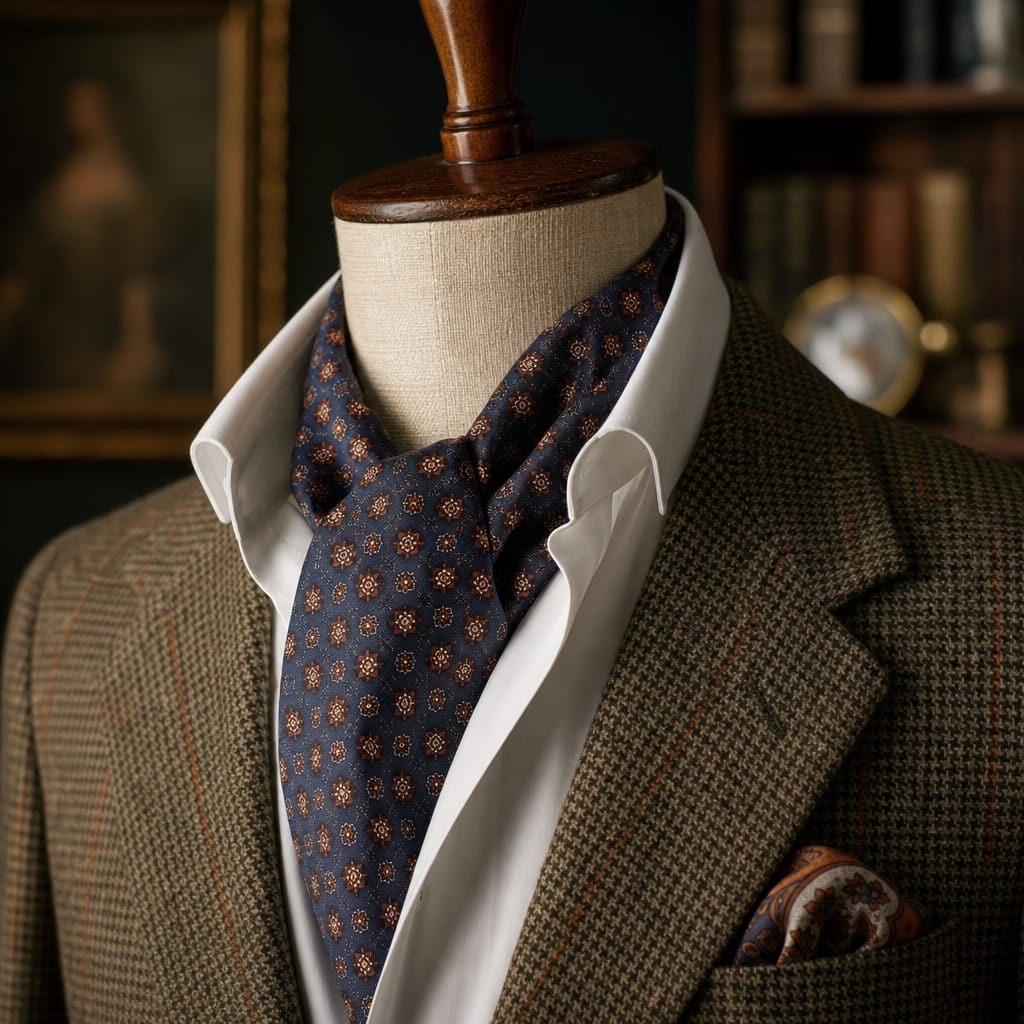
That specific behaviour – holding a casual shape without stiffness – was genuinely new. And into that new behaviour stepped the ascot: a wide strip of cloth worn loosely folded and crossed at the throat, often secured with a decorative pin. The pin was almost decorative in a second sense too. It wasn't doing enormous structural work, because the foulard was already doing it. The pin was there to signal, quite clearly, that this was intentional.
A New Way to Be Dressed Without Being Dressed Up
The social register the ascot opened up was one that hadn't previously existed in any coherent form: the gentleman at leisure, visibly at ease, but still unmistakably put together. The morning coat and the stiff cravat announced you were attending something. The ascot announced you were arriving at the races, or walking the grounds, or watching rather than performing – aristocratic negligence, but structured enough that nobody could mistake it for actual negligence.
This is why the ascot attached itself so firmly to events like Ascot itself – Royal Ascot being where the garment gets its commonly accepted name – and to the Edwardian idea of the country weekend. These were contexts where being formally dressed would have looked effortful and slightly wrong, but looking entirely relaxed would have looked graceless. Foulard held exactly that careful line between the two.
What the Pin Is Actually Doing
The pin, which people often assume is the ascot's defining detail, only makes sense in this light. It's not a fastening in any practical sense. It's punctuation – it tells anyone looking that the looseness you're seeing is chosen looseness, that the drape was placed, not fallen. The fabric holds the shape; the pin holds the meaning. Without foulard to do the structural work underneath, you'd need something far more engineered. The whole effect would collapse into a cravat or a bow tie, something formal and finished rather than deliberately, comfortably undone.