Somewhere in Britain right now, a team of people is deciding what shade of green you'll think you want to wear in 2027. Not guessing. Deciding. There's a mood board. There's a committee. There's a consensus. And by the time you see it in the shops and think "oh, that's nice, very me," the whole apparatus has already moved on to 2028.
Most people assume trends just… happen. A celebrity wears something, a subculture exports it, the internet amplifies it. But the colour of that item – the specific dusty sage or the burnt sienna or the muted burgundy – that was agreed years ago in a room by a group of people you've never heard of. The infrastructure behind it is older than you'd think. Considerably stranger, too.
The Viennese Technicians Nobody Remembers
In the 1930s, Central Europe was in the process of collapsing. Designers, textile merchants, atelier managers – many of them Jewish, most of them from Vienna and its orbit – left, and Britain and America absorbed a lot of them along with their working methods.
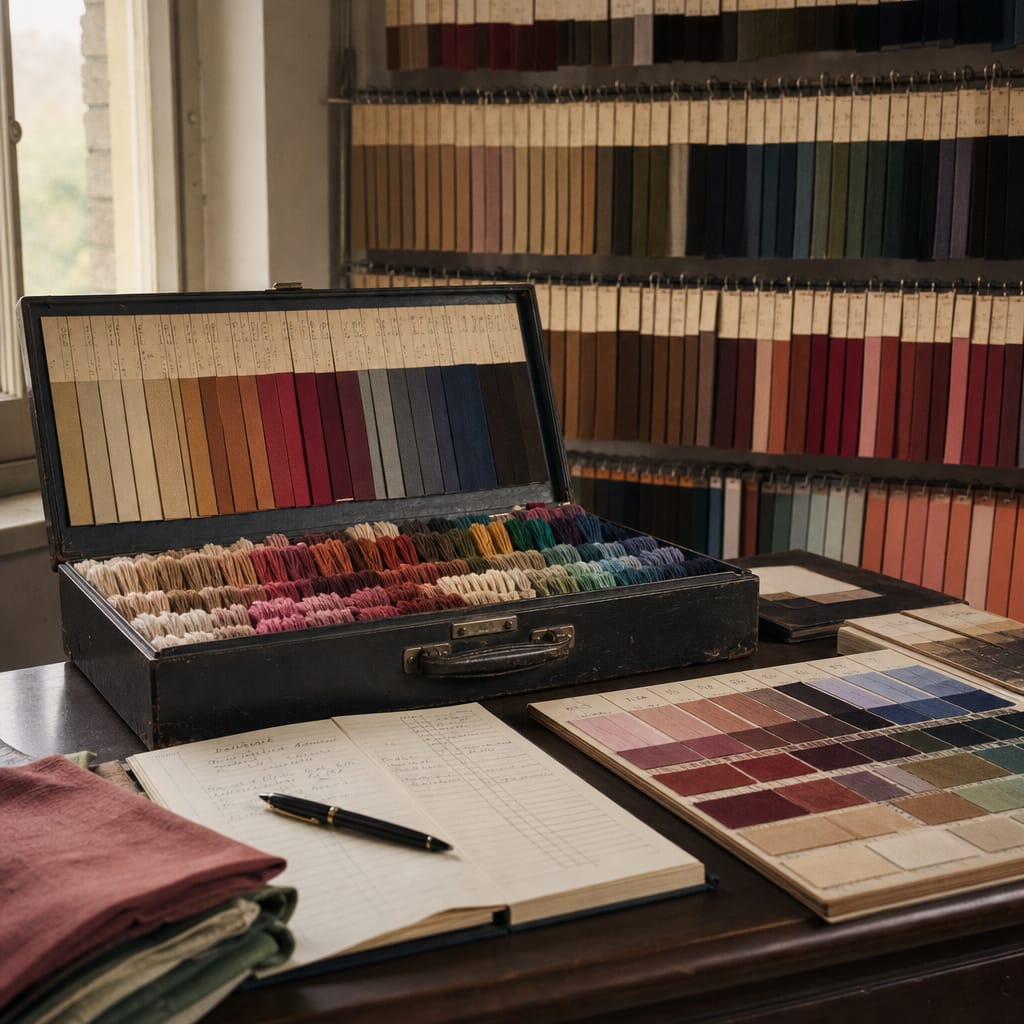
Inside the Viennese fashion system, seasonal colour decisions were not improvised. They were made in advance by closed committees, passed down to manufacturers, and treated with the gravity of a trade agreement. The palette for spring 1934 had probably been settled in 1932. This wasn't art; it was logistics. When you're co-ordinating silk dyers in Lyon, wool spinners in Yorkshire, and button-makers in Czechoslovakia, someone has to decide on the colour first or nothing matches and nobody can sell anything.
The émigrés who arrived in Britain didn't see why this system should stop at the border. They brought it wholesale into the British rag trade, where it had never really existed in that form before. British manufacturers, looking at the organised chaos of their own supply chains, could see immediately why it was useful.
Austro-Hungarian Guild Thinking, Dressed in British Wool
The result was the colour council – a body of industry representatives, dye manufacturers and fabric specialists who convened to agree on the coming season's palette. Not to predict it. To agree it, which is a very different thing. The colour didn't rise from the culture and get captured; it was issued from a committee and pushed down through the supply chain until enough people had bought into it that it became real.
This is the buried truth of trend forecasting: it's not archaeology, digging up what people want. It's more like legislation. A small group decides, the manufacturing system commits, retailers order accordingly, and eventually the thing appears as if from nowhere on every rack in every town. You think you're having a personal revelation about green.
The Machine That Runs on Its Own Authority
The forecasting industry today – WGSN, Pantone's colour of the year, the whole ecosystem of trend agencies – is this same Austro-Hungarian bureaucratic technology, just vastly scaled up and dressed in the language of cultural insight and consumer behaviour. The mood boards are more elaborate. The reports are more expensive. The authority is borrowed from the same place it always was: the fact that everyone else in the supply chain is reading the same document.
Which means the next time a colour sweeps through the shops and you can't quite explain why you suddenly want it, you're not wrong to feel that something has been arranged. It has. Years ago. By people whose names you don't know, working inside a system older than anyone in the room.
FAQ
What is a colour council in fashion?
A colour council consists of industry representatives, dye manufacturers and fabric specialists who meet to agree the coming season’s palette. The purpose of a colour council is not to predict trends but to decide on the upcoming season’s colours in advance so that the entire supply chain commits to the same colours before anything reaches the shops.
Where did the fashion colour committee system come from?
This practice originated in the fashion system of Vienna, where closed committees agreed on a colour palette for future seasons in advance. Many designers, textile merchants and atelier managers of Viennese provenance left Central Europe in the 1930s for Britain and America, where they brought with them their working methods. The rag trade in Britain followed suit in order to make the supply chain easier to coordinate.
How far ahead are fashion colours decided?
Years ahead. For the Viennese system the palette for spring 1934 was probably fixed in 1932. The early fixing of colours was essential for dyers, spinners and button-makers alike in order to ensure that everything matched. Today the fixing of 2027 colours will already be under way while the industry is gazing into the distance towards 2028.
Is trend forecasting about predicting or deciding colours?
Trend forecasting is more like legislation than archaeology. A small group agrees on a colour and manufacturers then commit to it. Retailers then place their orders and that colour will be on every rail. Modern agencies such as WGSN and Pantone’s colour of the year gain their authority from being read by everyone in the supply chain.