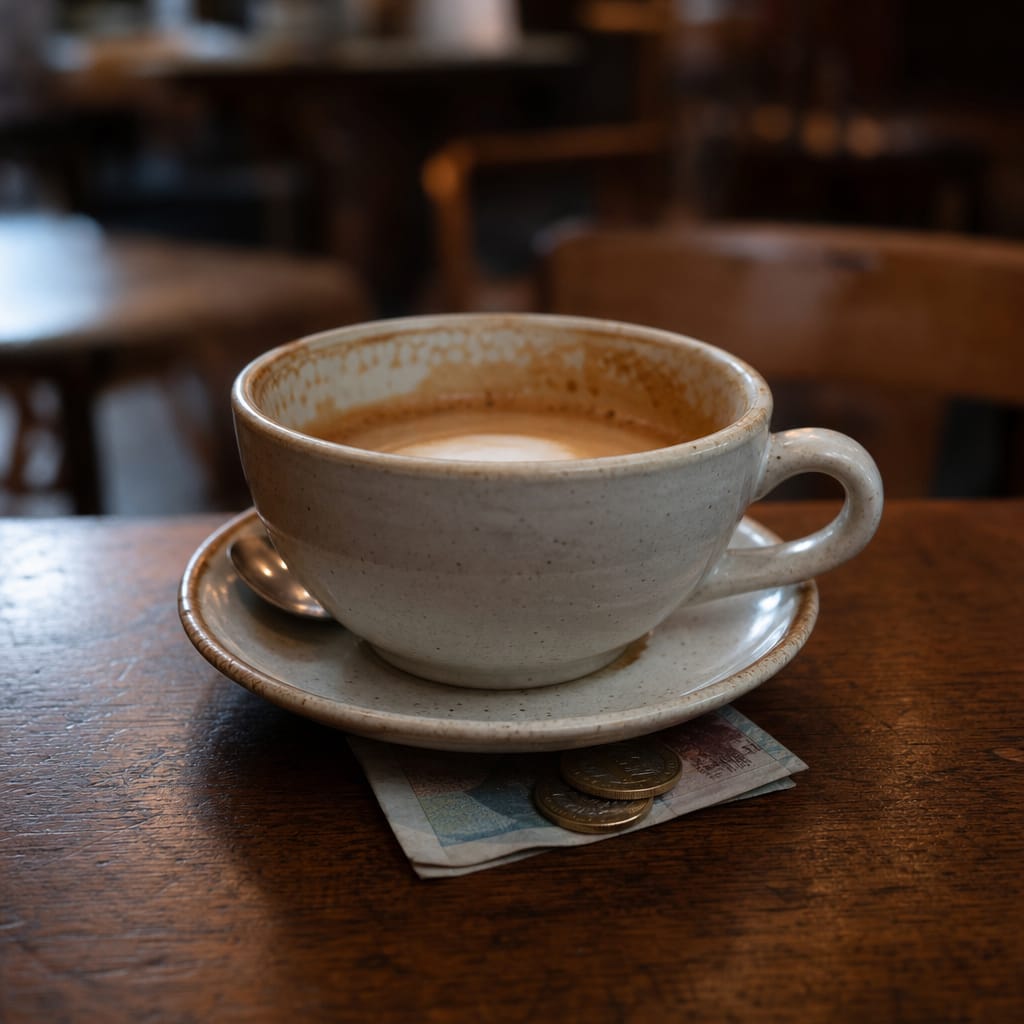
Slip a couple of quid under a coffee cup and you feel, just for a moment, like a generous person. The waiter feels, just for a moment, like they've been recognised. Neither of you examines what just happened too closely. That mutual agreement not to look is, it turns out, the whole history of tipping in a nutshell.
Where does the word tip really come from?
Ask someone where the word "tip" comes from and there's a decent chance they'll produce the coaching inn story. Customers at a busy inn, the tale goes, would drop coins into a box labelled "To Insure Promptness" – TIP. A tidy little origin myth, rational and commercial, the kind Victorians loved to stick onto murky customs to make them seem properly thought through. The problem is that it's almost certainly invented. The word "tip" as slang for giving or passing something along appears in print well before any such box was ever recorded. Trace it further back and it sits in a cluster of thieves' cant terms – slippery, fast-moving language used by people who needed to talk about exchanging things without being too specific about what those things were.
It's also probably cousins, in some roundabout way, with words meaning to topple or tilt: the quick transfer of something from one hand to another, gone before anyone gets a proper look. Which, honestly, suits the custom rather well.
Does tipping actually improve the service you get?
What the coaching inn story reveals, even in its wrongness, is the itch people have always felt to make tipping make sense. To frame it as a transaction with logic behind it: you pay for speed, you reward performance, the market operates cleanly. But tipping has never really worked like that. You tip generously at the end of a meal you've already eaten, for service you've already received and can no longer be improved. You tip a taxi driver for a journey that's over. The incentive theory, if you take it seriously for about thirty seconds, collapses.
What you're actually doing is something more like a social ritual. Both parties know it. Both parties agree, silently, to treat it as though it were commerce instead. The waiter doesn't say "this is arbitrary." You don't say "I have no idea what the right amount is." The fiction holds because it would be uncomfortable for everyone if it didn't.
Why Nobody Agrees on the Rules
This is also why tipping customs are so stubbornly, maddeningly inconsistent. If tipping were rational, you'd expect some logic to have settled on a standard by now. Instead, ten percent feels stingy in a restaurant but generous in a taxi; you tip a hairdresser but not a dentist; you tip in America at a coffee counter and feel faintly ridiculous for not knowing whether to tip in the same place here.
The rules aren't written down because there is no governing principle underneath them – only accumulated social habit, slightly different in every context, handed down by imitation rather than instruction.
The Coin Already in Motion
So next time you're hovering over the card reader, wondering whether fifteen percent is right or rude or expected, you're not making a commercial calculation. You're participating in a centuries-old piece of improvised theatre that started in the margins of the language, in cant and slang and the quick pass of something between hands. The coaching inn never had a box. But the instinct to pretend it did – to give the whole fuzzy thing a tidy name and a clean explanation – has been with us just as long as the custom itself.
Questions this raises
- Why did tipping take hold in Britain and not elsewhere?
- Was there ever a campaign to abolish tipping here?