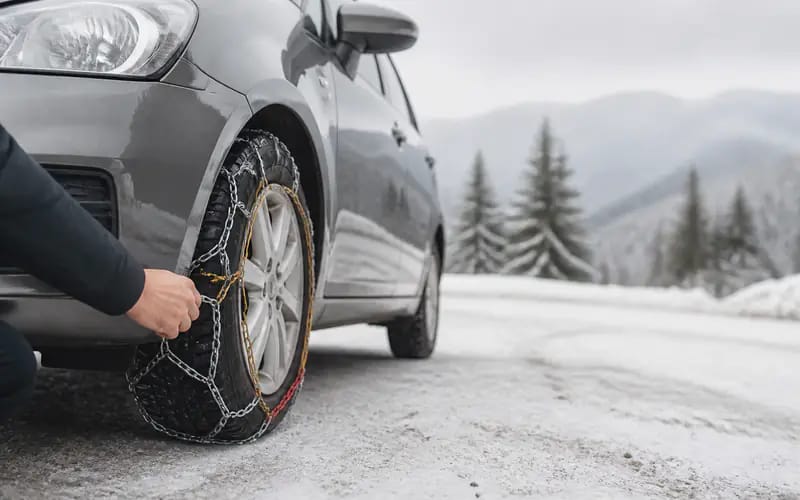
For people planning to travel to the Alps in winter there are several countries in which winter tires or snow chains are mandatory for parts of the roads. Below we outline the rules in France, in Andorra, in Switzerland and in Norway. Additionally we explain how to check if your hire car has got suitable tires for your journey.
What France’s Rule Actually Covers
Loi Montagne France: Equipment Requirement for Travelling to the Alps by Car
As previously mentioned, a Loi Montagne in France requires vehicles travelling to the Alps and the Pyrenees to be equipped with either winter tires or snow chains. In many cases, the relevant roads are clearly marked with signs displaying a tire with snow on it or a snowflake. However, it is not a national requirement and is restricted to certain mountain departments and roads, which are clearly signed. In general, motorways and other low-lying road will not be subject to this requirement. However, if you are travelling through mountain departments, you will need to ensure that your vehicle is properly equipped.
The Seasonal Window
The Loi Montagne winter equipment requirement applies from 1st November to 31st March every year. This means that even though it’s still early November and the mountains are cold, there’s no need for winter equipment on the French roads yet. However, if you’re travelling late March and the weather is still wintry, you’ll need to check if the requirement still applies before heading off.
Tyres or Chains, Your Choice
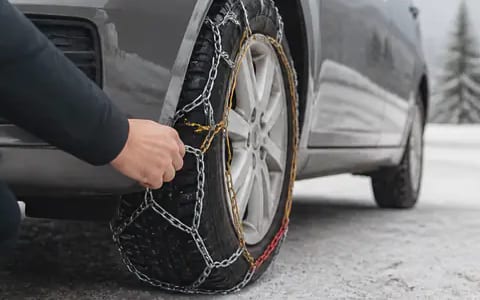
Alternatively you can carry snow chains and fit them as required under winter conditions as signalled by winter tire signs. Note that chains must be fitted correctly and only used on snow or ice covered roads and not on dry tarmac surfaces. This option may be more suitable for occasional use in the mountains rather than purchasing full sets of winter tires.
Spotting a Genuine Winter Tyre
Note that not all “all-season” or “winter tyres” products are created equal. Look for the snowflake symbol (the official 3PMSF symbol or “three-peak mountain snowflake” icon) in the sidewall, and refer to the FCDO travel advice page for Andorra for further information on what constitutes a compliant “winter equipment” tire. Note also that “M+S” tread is not necessarily the same thing as a 3PMSF tire. It’s always best to check the sidewall for the official symbol.
Hire Cars Are Your Responsibility
It’s also worth checking with your hire car supplier before you pick up the car and travelling abroad for winter trips to see if they supply chains for your hire car and what you need to do to take them with you. The government guidance for abroad travelling states that the driver of a vehicle is responsible for checking that it meets the equipment requirements for the country or countries that it will be travelling to.
Andorra’s Rules in Brief
Andorra’s rules on winter equipment for cars are similar to those in France. In both countries you can travel with winter tires or with snow chains. The official symbol for winter tires with 3PMSF approval is the snowflake. If you are travelling in the region of Andorra and also in France in the Alps or the Pyrenees it is wise to check the French rules for the mountain roads you will be travelling on as well as the Andorran rules for the same roads. If you want winter tyres france law, https://travelsnews.co.uk/tips/the-factory-that-sets-every-price-you-pay/ is a good place to start.
Switzerland and Norway Compared
The rule for Switzerland is not as clear cut as France’s and does not apply everywhere. Wherever conditions require, all drivers must use appropriate tires. The RAC’s country guide to France contains further details on this as well as details of the laws for other European countries including Norway. Importantly, note that what may satisfy a country’s rules for equipment required in winter may not be sufficient for another country on your tour.
Checking Before You Travel
Whether the rules, dates and mountain areas change from year to year is beyond my knowledge but do check the latest official travel advice before your trip. The BBC’s Europe section has provided excellent coverage of the winter equipment required in France in recent years, and their travel section’s Andorra page even specifically notes how to identify winter tires (3PMSF symbol) as required by the French rules for mountain areas. However, the main travel advice page for France provides the up to date information for all travel to France and should be consulted before travel. The way that fuel prices are set for individual garages and even individual forecourts abroad can vary greatly and is explained in another article.
Winter Driving Rules Compared
Can you tell me when winter tyres are compulsory in France? They are compulsory on the following routes in the French mountains for winter conditions between 1 November and 31 March.
Yes, in France and in Andorra it is enough to have either winter tires or chains to be able to drive on the roads which require winter equipment.
What does a winter tyre look like? A winter tyre is a tyre that displays a snowflake symbol (the FCDO refer to this as the 3PMSF – three-peak mountain snowflake symbol) on the sidewall.
Are snow chains provided by the hire car company? (Gov. UK – Check your vehicle before travelling abroad).
Norway: winter tires with a minimum tread depth of 3mm must be fitted on roads with snow or ice on the ground. Studded tires or snow chains may also be required and in some cases be obligatory in certain regions.
Check out the current official government travel advice for each country you are travelling through on your winter Alps road trip before you set off.